Skix CS (this site)
Answers product questions and takes demo and quote requests. Answers are returned with citations, grounded in this user guide; without evidence it refuses and hands off to a staff member.
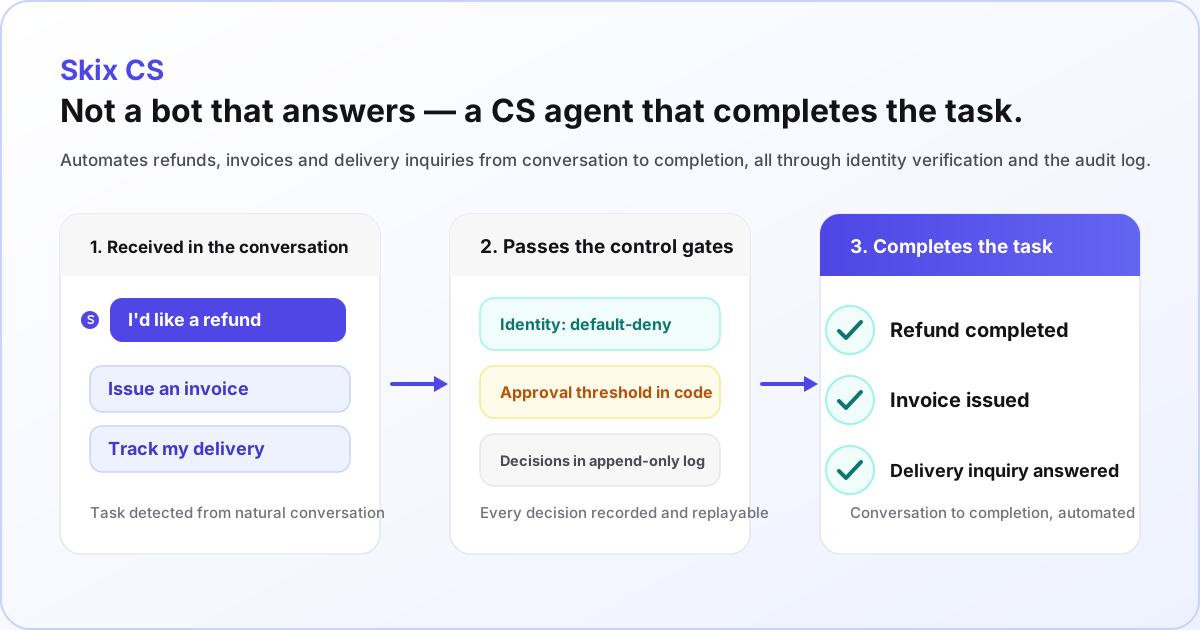
Skix CS is a customer support AI agent platform that does more than answer inquiries: it carries out identity verification, approval, execution and recording and completes the task. Approval rules are enforced in code, not prompts, so a conversation can never break them.
With business APIs, onboarding takes 0.5–1 day. Without APIs, you can start with FAQ answers and human handoff.
Skix's three services run in production on Skix CS, each as an independent tenant. The Web widget at the bottom right is one of them — not a diagram or a demo video, but the live production environment you can touch directly.
Answers product questions and takes demo and quote requests. Answers are returned with citations, grounded in this user guide; without evidence it refuses and hands off to a staff member.
Inquiry desk for service users and visitors. Serves Japanese, Chinese and English users, automatically matching the conversation language.
Support desk for an enterprise service. The knowledge base gives the first answer; inquiries with no evidence or that need a judgment call go to the handoff queue in the Operator workbench.
We make the automation of refunds, invoices and delivery inquiries something you can delegate — not by "trusting the AI", but because controls, identity verification and auditing work as structure.
Approval thresholds and refund limits are implemented in code, not prompts. Amounts above the threshold go to human approval; anything over the limit is rejected immediately. Clever conversations and prompt injection cannot move them.
→ "The AI issued a refund on its own" never happensDeterministic matching of the order number and the last 4 digits of the phone number. Default-deny design: an unverified conversation never touches customer data. Even an anonymous visitor on LINE or the web can proceed as the verified customer once the match passes.
→ Prevents impersonation-based data leaks by structureEvery conversation and every decision is recorded as append-only events, and any session can be replayed exactly as it happened. "When, what and why" can be explained after the fact. A GDPR erasure API is also provided.
→ Answer customer disputes and audits with the logBelow the evidence threshold it does not generate — it honestly says "I don't know" and connects you to a person. Answers carry source citations, and your existing FAQ can be bulk-imported.
→ Never lose trust to a plausible wrong answerWhen in doubt it hands off to a person, and the AI stays silent while a human is handling the conversation. Approval queue, handoff queue, knowledge drafts and quality review in one workbench. Neglected approvals get reminders; expired ones are cancelled automatically and the customer is notified.
→ Keep your existing support team as it isAutomatically follows Japanese, Chinese and English, and keeps up when the customer switches. Long-term memory behind a PII gate enables responses informed by each customer's context.
→ The same quality for inbound and cross-border customersWhichever channel it comes from, a request passes identity verification, policy decision and audit recording before it reaches the tenant's business APIs. The LLM is "a component that assists decisions"; it has no authority to execute tasks.
No large project required. Four steps take you through acceptance testing. If you don't have business APIs yet, skip step 2 and start with FAQ answers and human handoff.
Create a dedicated tenant on the multi-tenant platform. Set approval thresholds, refund limits and budget limits per tenant.
Connect your business APIs (orders, refunds, shipping, invoices, customers) through five connectors. JSON plus a single auth header is all it takes, with a circuit breaker built in.
Bulk-import your existing FAQ into the knowledge base (with a dry run). Answers carry citations and are refused when evidence is insufficient.
Verify identity verification, the approval flow and handoff with real data, validate the audit log by replay, and go live.
0.5–1 day in total — the standard onboarding time when business APIs are available.
Start without APIs — begin with FAQ answers + human handoff, connect business APIs later.
Yes. You can start with knowledge-base answers from your existing FAQ and human handoff alone (this site itself runs that configuration). Automatic execution of refunds, invoices and delivery inquiries becomes active once your business APIs are connected through connectors.
An individual quote based on monthly conversation volume, connected channels and the number of connected systems. We welcome inquiries starting from a small PoC. Tell the chat at the bottom right "I'd like a demo", or contact [email protected].
Two layers of structure protect you. First, the knowledge base (RAG) is refusal by design — below the evidence threshold it does not generate but honestly refuses, and answers carry citations. Second, policies such as approval thresholds and limits are implemented in code, not prompts, so prompt injection cannot move them. Amounts above the threshold go to human approval; anything over the limit is rejected immediately. Uncertain cases are handed off to an operator.
We connect to your business APIs (orders, refunds, shipping, invoices, customers) through five connectors, with a circuit breaker built in. Tasks such as refunds, invoices and delivery inquiries run idempotently on a fault-tolerant workflow engine, so a mid-way failure never causes double execution. On the customer side we support REST API, Web widget and LINE.
Operators handle the approval queue and the handoff queue in the workbench. A person replies in conversations the AI has handed off, and can return them to the AI once resolved. While a human is handling a conversation, the AI does not speak. Answers born from human support can be promoted to the knowledge base as FAQ drafts.
On the multi-tenant platform, tenants are isolated by database row-level security (RLS). Policies and budget limits are also set per tenant. In addition, each conversation passes an identity gate: unless the deterministic match of the order number and the last 4 digits of the phone number passes, no customer data is accessed at all (default-deny).
Yes. A GDPR erasure API is provided. Every conversation and every decision is also recorded as append-only events, and any session can be fully replayed, so "when, what and why" can be verified after the fact. Personalization through long-term memory is also behind a PII gate.
Three channels: REST API, Web widget and LINE. The Web widget is just an iframe to embed; LINE only needs the Webhook setting on your official account. Languages: Japanese, Chinese and English, automatically following the customer's language.
Tell the chat at the bottom right "I'd like a demo" — that itself is a demo of Skix CS. With business APIs, it's live in 0.5–1 day.
Existing customers can log in at the Tenant console.